Situation and product: „The Iron Curtain“

In your journalism workshop you have realized that making podcasts for radio stations is not easy. But you decided to do it, to see which format is best, to find good content and the best music. After you met students from different countries from the former Soviet block you decided on producing podcasts on different stations in the Rise and Fall of the Iron Curtain. Before you focus on the podcasts you work through the tasks on the background and on the stations of the rise and fall of the Iron Curtain.

The rise and fall of the Iron Curtain

Who coined the phrase „Iron Curtain“?

Sir Winston Churchill - 19086236948.jpg
Von BiblioArchives / LibraryArchives – https://www.flickr.com/photos/28853433@N02/19086236948/, Gemeinfrei, Link

Sir Winston Leonard Spencer-Churchill, (30 November 1874 – 24 January 1965) was a British politician who was the Prime Minister of the United Kingdom from 1940 to 1945 and again from 1951 to 1955. He was widely regarded as one of the greatest wartime leaders of the 20th century.

1 The sinews of peace by Sir Winston Churchill: Tasks on video and speech:

1. Watch the video and get a feel for the time and the then current situation.

2. Why is this speech delivered by Churchill  on 5 March 1946 at Westminster College, Fulton, Missouri iconic?

Aus datenschutzrechtlichen Gründen benötigt YouTube Ihre Einwilligung um geladen zu werden. Mehr Informationen finden Sie unter Datenschutz.

The sinews of peace by Sir Winston Churchill

This is an excerpt from sinews of Peace, it´s not the same excerpt as shown in the video.

President McCluer, ladies and gentlemen, and last but certainly not least, the President of the United States of America:

I am very glad indeed to come to Westminster College this afternoon, and I am complimented that you should give me a degree from an institution whose reputation has been so solidly established. […] t is also an honor, ladies and gentlemen, perhaps almost unique, for a private visitor to be introduced to an academic audience by the President of the United States. Amid his heavy burdens, duties, and responsibilities — unsought but not recoiled from — the President has traveled a thousand miles to dignify and magnify our meeting here today and to give me an opportunity of addressing this kindred nation, as well as my own countrymen across the ocean, and perhaps some other countries too. […]

The safety of the world, ladies and gentlemen, requires a new unity in Europe, from which no nation should be permanently outcast. It is from the quarrels of the strong parent races in Europe that the world wars we have witnessed, or which occurred in former times, have sprung. Twice in our own lifetime we have seen the United States, against their wishes and their traditions, against arguments, the force of which it is impossible not to comprehend. Twice we have seen them drawn by irresistible forces into these wars in time to secure the victory of the good cause, but only after frightful slaughter and devastation have occurred. Twice the United States has had to send several millions of its young men across the Atlantic to find the war; but now war can find any nation, wherever it may dwell between dusk and dawn. Surely we should work with conscious purpose for a grand pacification of Europe, within the structure of the United Nations and in accordance with our Charter. That, I feel, opens a course of policy of very great importance.

In front of the iron curtain which lies across Europe are other causes for anxiety. In Italy the Communist Party is seriously hampered by having to support the Communist-trained Marshal Tito’s claims to former Italian territory at the head of the Adriatic. Nevertheless, the future of Italy hangs in the balance. Again one cannot imagine a regenerated Europe without a strong France. All my public life I worked for a strong France, and I never lost faith in her destiny, even in the darkest hours. I will not lose faith now.

However, in a great number of countries, far from the Russian frontiers and throughout the world, Communist fifth columns are established and work in complete unity and absolute obedience to the directions they receive from the Communist center. Except in the British Commonwealth and in the United States where Communism is in its infancy, the Communist parties or fifth columns constitute a growing challenge and peril to Christian civilization. These are somber facts for anyone to have recite on the morrow a victory gained by so much splendid comradeship in arms and in the cause of freedom and democracy; but we should be most unwise not to face them squarely while time remains. […]

On the other hand, ladies and gentlemen, I repulse the idea that a new war is inevitable — still more that it is imminent. It is because I am sure that our fortunes are still in our own hands and that we hold the power to save the future, that I feel the duty to speak out now that I have the occasion and the opportunity to do so. I do not believe that Soviet Russia desires war. What they desire is the fruits of war and the indefinite expansion of their power and doctrines. But what we have to consider here today, while time remains, is the permanent prevention of war and the establishment of conditions of freedom and democracy as rapidly as possible in all countries. Our difficulties and dangers will not be removed by closing our eyes to them. They will not be removed by mere „waiting to see what happens.“ Nor will they be removed by a policy of appeasement. What is needed is a settlement, and the longer this is delayed, the more difficult it will be and the greater our dangers will become. […]

Winston Churchill, The Sinews of Peace. Quoted in Mark A. Kishlansky, ed.

2 The Iron Curtain: Tasks on an excerpt from Madeleine Albright´s biography

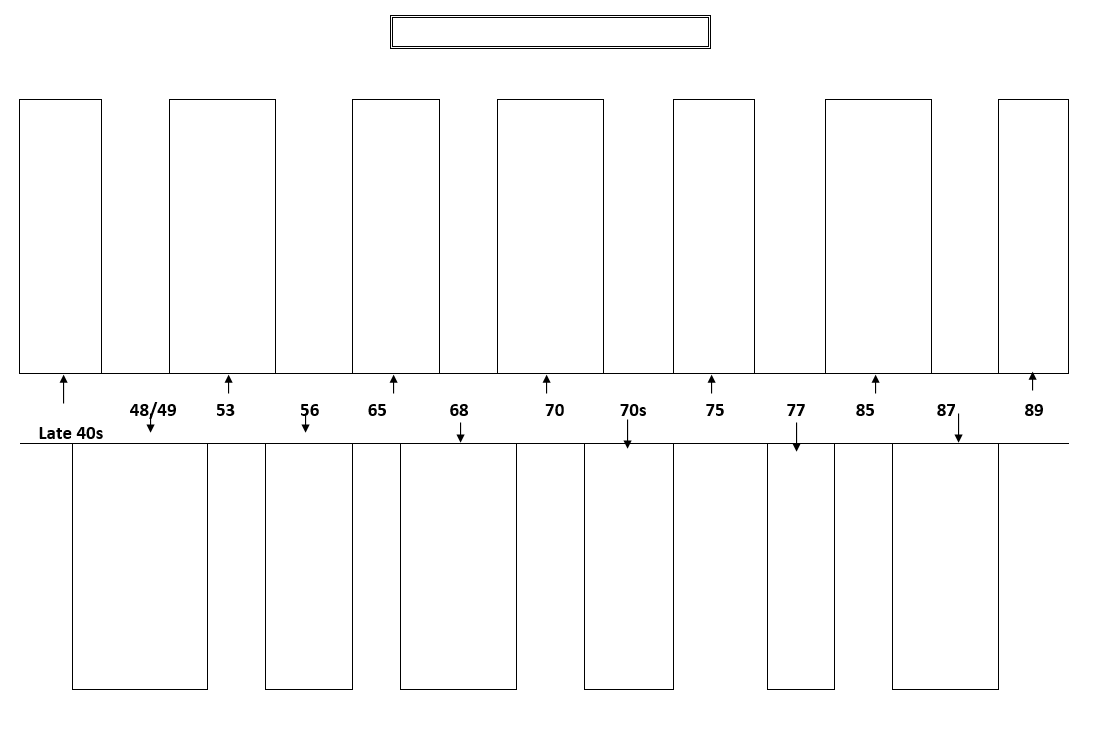
1 Please read the text and note down the milestones in the rise and fall of the Iron Curtain. You can copy and use the timeline provided underneath.

2 Decide which incident you consider most important, on which you want to make your podcast.

Madeleine Albright on the Iron Curtain

She was born Marie Jana Korbel on May 15, 1937 in the  CzechRepubilc and became American politician and diplomat. She is the first woman to have become the United States Secretary of State on January 23, 1997.

(A) The Iron Curtain had come upon Central and East Europe in the late 1940s. In most places the voices of protest were stifled and, to the West, unheard; but once or twice a decade a wind arose that caused the Curtain to part just long enough to keep up hope that freedom would one day be restored.

(B) In 1948, Tito broke with Stalin.

In 1953, there were riots in East Germany leading to the German Unification Day.

In 1956 first the Poles, then the Hungarians tried to rebel.

In 1968, it was the Czechoslovaks‘ turn.

(C)In the late 1970s, Polish dockworkers launched the Solidarity movement.

Then there was Nicolae Ceausescu in Romania, whose rule began in 1965 and lasted almost a quarter century. At the beginning he was a breath of fresh air, challenging the Soviets and proposing reforms, before he turned into a destructive tornado.

(D) The cement holding the Soviet empire together had been stressed, but it didn’t crack until 1985, when Mikhail Gorbachev became General Secretary of the Soviet Communist Party. Gorbachev designed a program of economic restructuring (perestroika), combined with a new social and intellectual approach (glasnost) that challenged the opinions upon which the Soviet System had been built. He made clear that the satellite states no longer had to take orders from Moscow. Suddenly the emperor was more liberal than his princes. The aging, backward-looking leaders of the satellites were shown as inept hacks; the change in Soviet attitudes supported changes throughout East Europe. Dissident movements bloomed and thrived.

(E) The Hungarians made economic and political reforms, developing their unique brand of „goulash Communism.“

In Poland authorities were pressured into giving Solidarity a second life.

East German officials thought they had everything under control until Gorbachev, here to help celebrate their regime’s forty-second anniversary, warned that without change there would be massive popular resistance.

(F) Relatively little attention was paid to Czechoslovakia, and I understood the reasons for that. The Soviet invasion of 1968 had broken the spirit of many. People turned inward and spent as little time as possible at their jobs. Instead they put their energy into building weekend-homes in the country-side, or chatas, to which they disappeared as early on Fridays as they could. But the seeds of Prague Spring, not altogether destroyed, began slowly to push back above ground.

(G) Oddly, American rock music provided one source of support. A group called the Plastic People of the Universe, named after a Frank Zappa song, was formed one month after the Soviet invasion. Its concerts attracted such large crowds that the authorities prohibited the group from playing in public. Planning in secret, the band continued to play, until its members were arrested and charged with disturbing the peace and playing music with an „antisocialist and antisocial impact.“ The group’s trial was viewed as a key test by intellectual dissidents. Shortly after its conviction, on January 1, 1977, more than 250 writers, professors, and human rights activists signed a manifesto—Charter 77— calling upon the Czechoslovak government to respect the civil and political rights embodied in the Helsinki Final Act, which Soviet bloc members had signed sixteen months before. One of the leaders of Charter 77 was Vaclav Havel, who was arrested several times and spent more than four years in jail.

(H) Religion also played a role. Even to young people raised as atheists, defrocked Catholic clerics became heroes. The priests, forced to take menial jobs such as cleaning latrines, held secret church services. But until 1989, these and other moments of rebellion seemed no match for the crushing weight of the Communist state.

(J) I was naturally curious about events in my native land, and in 1986 used the chance to visit as part of a U.S. Information Agency educational program

3 Creating a podcast.

Creating podcasts

After you have decided which stage of the the rise and fall of the Iron Curtain you find most iconic and thus want to produce a podcast on start working on it. Ideally you do that in a group.

If you work in class destribute the stages among yourselves so that the whole period in history is covered.

If you need help with your podcast consult Youtube there are numerous good clips.

Quellen:

Declaration of Independence: Aufgabenmodul aus segu Geschichte (OER, CC BY SA 4.0)