

Social Media: Regulate social media now. The future of democracy is at stake.
Situation
You are a member of the school magazine and you want to publish an article on the dangers and opportunities of social media.
Getting informed
Read the following text and complete the tasks. The text will provide relevant information on the dangers of social media but shows solutions as well.
Text: Regulate social media now. The future of democracy is at stake.
(A) A few days ago, ProPublica, an independent, nonprofit newsroom, discovered that a tool it was using to track political advertising on Facebook had been quietly disabled — by Facebook. The browser extension had detected political ad campaigns and gathered details on the ads’ target audiences. Facebook also tracks political ad campaigns, but sometimes it fails to detect them. For the past year, the company had accepted corrections from ProPublica — until one day it decided it didn’t want them anymore. It also seems like “they don’t wish for there to be information about the targeting of political advertising,” an editor at ProPublica told me.
(B) Why does it matter? Because this is the information network that now brings most people their news and opinions about politics, about medicine, about the economy. This is also the information network that is fueling polarization, that favors sensational news over constructive news and that has destroyed the business model of local and investigative journalism. The past few days have also brought news of staff layoffs at newspapers around the country, from Arizona to Tennessee to New Jersey.
(C) There is a precedent for this historical moment. In the 1920s and 1930s, democratic governments suddenly found themselves challenged by radio, the new information technology of its time. Radio’s early stars included Adolf Hitler and Joseph Stalin: The technology could clearly be used to provoke anger and violence. But was there a way to marshal it for the purposes of democracy instead? One answer was the British Broadcasting Corp., the BBC, which was designed from the beginning to reach all parts of the country, to “inform, educate and entertain” and to join people together, not in a single set of opinions but in the kind of single national conversation that made democracy possible. Another set of answers was found in the United States, where journalists accepted a regulatory framework, a set of rules about libel law and a public process that determined who could get a radio license.
(D) The question now is to find the equivalent of licensing and public broadcasting in the world of social media: to find, that is, the regulatory or social or legal measures that will make this technology work for us, for our society and our democracy, and not just for Facebook shareholders. This is not an argument in favor of censorship. It’s an argument in favor of applying to the online world the same kinds of regulations that have been used in other spheres, to set rules on transparency, privacy, data and competition.
(E) We can, for example, regulate Internet advertising, just as we regulate broadcast advertising, insisting that people know when and why they are being shown political ads or, indeed, any ads. We can curb the anonymity of the Internet — recent research shows that the number of fake accounts on Facebook may be far higher than what the company has stated in public — because we have a right to know whether we are interacting with real people or bots. In the longer term, there may be even more profound solutions. What would a public-interest algorithm look like, for example, or a form of social media that favored constructive conversations over polarization?
(F) If we don’t even try to find solutions, we will not be able to ensure the reliability of elections or the decency of the public sphere. If we don’t do it, in the long term there won’t even be a public sphere, and there won’t be thriving democracies anymore, either.
Source: Anne Applebaum (Washington Post Online). February 1, 2019 (abridged and adapted)
Task: Short-answer questions
Answer the questions by providing the information from the text
(Paragr. A and B).
- Why did Facebook probably disable the tool used for tracking political advertising? (1)
- What are the side-effects of Facebook being an important information network? (3)
Lösungen
Task: Mediation
Beantworten Sie die folgenden Fragen auf Deutsch (Absätze D-F).
- Anhand welcher Beispiele zeigt die Autorin die Sinnhaftigkeit einer Regulierung des Internets? (4)
- Wovor warnt die Autorin im Hinblick auf Wahlen und die Demokratie? (2)
Lösungen
Task: Gapped summary
Fill in the blanks with words from the text (Paragraphs C and E).
There are certain drawbacks of living in times of Facebook and Google. People find themselves confronted with plenty of ideas and opinions, which often causes polarization rather than constructive conversations. When looking at the history of information technology the emergence of the radio and its challenges can be seen as a ______1_______. Back then the BBC found a way to ______2_______ those challenges to help serve democracy. Across the pond, the press agreed to a ______3 (two words)_______ , which included for example libel laws and which also controlled who would be allowed a radio license. In order to protect our democracy and thus society and ourselves we need to adapt the rules from the past to the world of social media today and find the equivalent of licensing and public broadcasting. In addition, we need to ______4_______ the rising problem of fake accounts and internet anonymity by applying certain regulations. Companies such as Facebook and Google operate according to their own rules and decide which data gets collected and who sees it. Finding ______5 (two words)_______ to this growing problem will therefore be an important issue in the future.
Lösungen
Material Based Writing
Social media is viewed as a highly controversial topic and therefore you want to give a broader perspective on this topic in your school magazine.
Task:
1 Use the message of all the sources below for your argumentation. Write at least 300 words


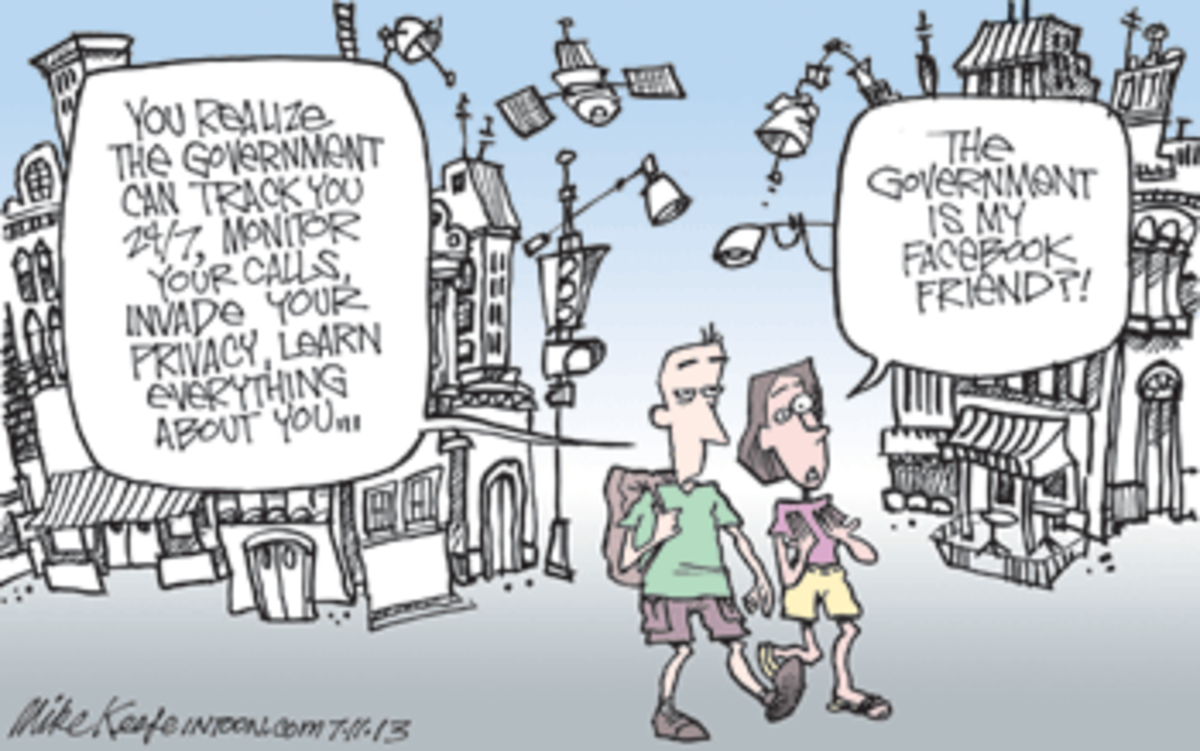
Source 2:

https://www.laprogressive.com/wp-content/uploads/2013/07/government-facebook-350.gif, 30.01.2018
Source 3:
Jürgen Pfeffer: Das heißt, wenn Sie heute Ihr Facebook aufmachen, dann ist das ja nicht das Ergebnis von dem, was all Ihre Freunde sagen, sondern – es stimmt schon, darunter ist die Information von all Ihren Freunden und Bekannten -, aber was Sie tatsächlich zu sehen bekommen, ist das, was Facebook denkt, das Sie lesen wollen. Das heißt, hier findet algorithmische Entscheidung darüber statt, was Sie wahrscheinlich sehen wollen.
How to approach material based writing:
Step 1: Understanding the task
Read the situation and the task. Make sure you fully understand the topic!
Step 2: Analysing the material
Look at the material given and make sure you understand the message provided in the different sources.
What is the message of each source?
Mark the right answer.
Step 3: Structuring
- Brainstorm your ideas on the topic.
- Structure your arguments, including the material you want to use as examples/ explanations, etc.
- Make sure the arguments are logically connected to the subject.
- Note down some useful vocabulary on the topic.
Step 4: Writing
- Introduce the topic in general and state the problem. You may already use information from a source (e.g. message of cartoon, etc.).
- Present each of your arguments in a well-structured paragraph:
- Present a general statement to convey your main idea in a topic sentence.
- Give reasons for your point of view (explanation) and provide suitable examples/evidence to support your line of argumentation (e.g. information from one of the materials).
- Use linking words and phrases to guide the reader through the argument thus producing a coherent text.
- Draw a conclusion, by drafting a solution to the problem, giving a future outlook, etc.